Submit your session proposal for the ESIP January 2027 Meeting. Submissions are open through November 19.

ESIP Lab Request for Proposals
Small grants with big impact. We provide funding for Earth science data, technology, and computing projects that make time for learning technical skills.

Title: Connected Data: Interoperability, Discovery, and AI-Ready Access
Award: $10,000 – $25,000
# of awards: 1-3
Proposal Deadline: Dec 14, 2026
Period of Performance: Feb 1, 2027 – Aug 30, 2027
Contact & Proposal Questions: [email protected]
ESIP’s mission is to empower innovative use and stewardship of Earth science data to solve our planet’s greatest challenges. As part of that mission, this solicitation seeks proposals that address the issue of interoperability, discovery, and AI-ready access of those data.
Additionally, we encourage technical skill-building for awardees as part of their funded projects. By promoting learning within project solicitations, the ESIP Lab seeks to increase the collective technical savvy of the Earth science community and promote transparency about the job skills required to understand our changing planet.
Priority Area — Connected Data: Interoperability, Discovery, and AI-Ready Access
This year’s priority area reflects needs raised by both federal partners and participants at the July 2026 ESIP Meeting. It has three sub-areas; proposals should address one.
1. Cloud-Native Format & ARCO Tooling
Proposals that close specific, named gaps currently blocking adoption of analysis-ready, cloud-optimized (ARCO) data formats, such as:
- A command-line inspection tool for Zarr stores (a “Zarr dump” equivalent).
- A NetCDF-compatibility interface for Zarr/Icechunk-based data.
- A demonstrated, working interoperable data pipeline that resolves incompatible chunking schemes across tools.
2. Metadata Into Knowledge: A Discovery Layer
Proposals that move metadata beyond bare discoverability toward documenting a dataset or model’s genuine fitness for a specific purpose, such as:
- A crosswalk or merged profile reconciling existing fitness-for-purpose frameworks, tested against real datasets with documented failure modes.
- An automated compliance linter that checks a defined class of data products against the standards they claim to meet, runnable by producers before publication.
3. Machine-Actionable Data for AI Agents
Proposals that make Earth science data catalogs usable by AI agents, not just by software or human users, such as:
- Porting an existing, working reference pattern for AI agent access to a data catalog (e.g., an MCP server) to one or two additional catalogs, and publishing it as a reusable template.
- An agent- and machine-readable access layer over an existing database that is not currently usable by AI agents.
- A provenance representation for data that has passed through multiple stages of AI inference, demonstrated end to end on one real pipeline.
- A machine-readable “context file” convention that helps an AI agent correctly scope a search against a repository it doesn’t already know, with reference implementations at two or three repositories.
Although priority will be given to proposals addressing the sub-areas above, we will also consider high-quality proposals related to:
- The extension of open-source software critical to collecting, distributing, accessing, fusing, or analyzing Earth science data.
- Eligibility
- General Selection Criteria
- Budget Guidance
- Reporting & Travel
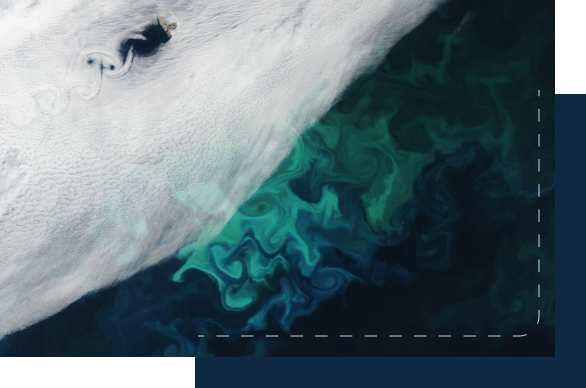
Photo from NASA
- The Principal Investigator is not part of ESIP’s elected leadership.
- The Principal Investigator has not been funded through the ESIP in the past year.
- Civil servants are eligible to serve as a PI or Co-I, but are restricted from receiving ESIP funds. If a Civil Servant serves as PI, all funded awards must be routed to a co-investigating non-federal partner institution.
- FY27 ESIP Lab grants are funded by NASA and NOAA, with ESIP serving as a pass-through entity (PTE). Awardees will receive federal subawards, subject to CFR 200 compliance rules.
- Applicants agree to comply with applicable federal regulations, including maintaining an active Unique Entity Identifier (UEI).
- Entities and PIs may not be listed as excluded, prohibited, or disqualified from receiving federal funds in SAM.gov. (Note that full SAM.gov registration is not mandatory in order to receive a UEI.)
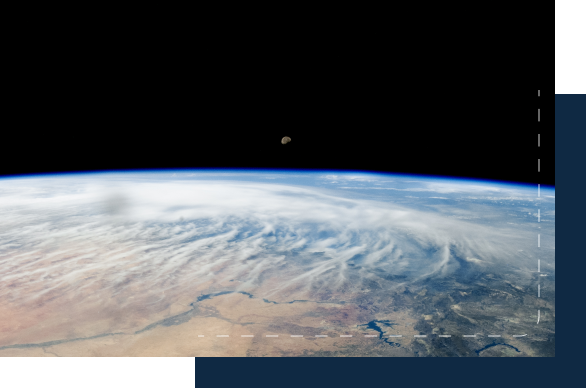
Photo from NASA
- Overall Impact: How likely is it that the project’s outcomes will lead to new knowledge, usable technology that others in the Earth science data community adopt, or follow-on funding?
- Objectives: Does the proposal include clear, measurable technical and learning objectives?
- Significance and Alignment: Does the project address an important problem or critical barrier within one of the 2026 focus areas: cloud-native data formats and analysis-ready, cloud-optimized (ARCO) tooling; moving from metadata to knowledge and discovery; or making Earth science data machine-actionable for AI agents?
- Approach and Feasibility: Are the strategy, methods, and analyses sound and suited to the project’s aims? Does the proposal identify potential problems, alternative strategies, and benchmarks for success? Can the proposed work realistically be completed within the project period?
- Innovation: Does the project use creative problem-solving or novel approaches?
- Collaboration: Is the project a collaboration between institutions, agencies, or sectors? Does it engage the broader ESIP community, such as relevant ESIP clusters?
- Openness and Reuse: Will the outputs (code, workflows, templates, documentation) be openly licensed, documented, and shown working on real data, so that others can adopt or extend them?
- Budget: Is the budget a reasonable use of resources for the amount requested? Is the project’s scope matched to its funding and timeline?

Photo from NASA
ESIP pays out awards based on deliverables (acknowledging that salary and hardware are needed to complete those deliverables). When you structure your project budget, include the tasks to be completed and the projected cost:
- Correct Formatting: Deliverable 1: Build a community weather dashboard to view current daily temperature and 30-year temperature normals and year-to-date precipitation = $5000
- Incorrect Formatting: 80 hrs salary at $50/hr = $4000 | Purchase computer = $1000
ESIP does not pay indirect costs in addition to the budget for deliverables.
The ESIP Lab can provide access to AWS cloud services for your project, and these costs won’t need to be included in your project budget. Please reach out to ESIP to discuss the details and how we can support your project.
In your proposal, please provide a plan detailing:
- Which AWS cloud services you’ll need.
- How these services will contribute to your project’s success.
You can keep any cloud instances active for the initial duration of your project. However, please include a plan to migrate or turn off these instances within one year of your project’s completion.
While we recommend using AWS due to the sponsored services, you are not required to use AWS. If you prefer another cloud provider, the costs for those services must be included in your overall project budget.

Projects chosen for an award will be expected to do the following:
- Create a page under the ESIP GitHub organizational (https://github.com/orgs/ESIPFed) account that includes the project overview, learning objectives, timeline, and goals.
- Upon project completion, the results and any code and/or a snapshot of the cloud instance should also be included in the page. This page will be your final report, so upon project completion, it should provide all pertinent information, including measures of outreach and impact of project deliverables.
- All project pages and associated code should include a permissive license.
- Give a presentation or poster at an ESIP Meeting or Collaboration Area call within one year of project completion.
Travel to Meetings or workshops during the period of performance must be included in your project budget; additional travel funding is not provided. Presentations given after the period of performance are encouraged, but associated travel and other costs cannot be charged to the award.
How to Apply
- Please use this template to create your proposal then submit the PDF.
- Proposals may be submitted up to December 14, 2026.
- Notification of acceptance will be in early-mid January 2027.
- For questions regarding eligibility or proposal scope, please contact [email protected].
NOTE: Proposals are open and may be published on the ESIP Lab website if your project is accepted.