Join us in Austin, TX this summer for the ESIP July Meeting! Early Registration and Call for Session Proposals now open.

Welcome to Spark@AGU
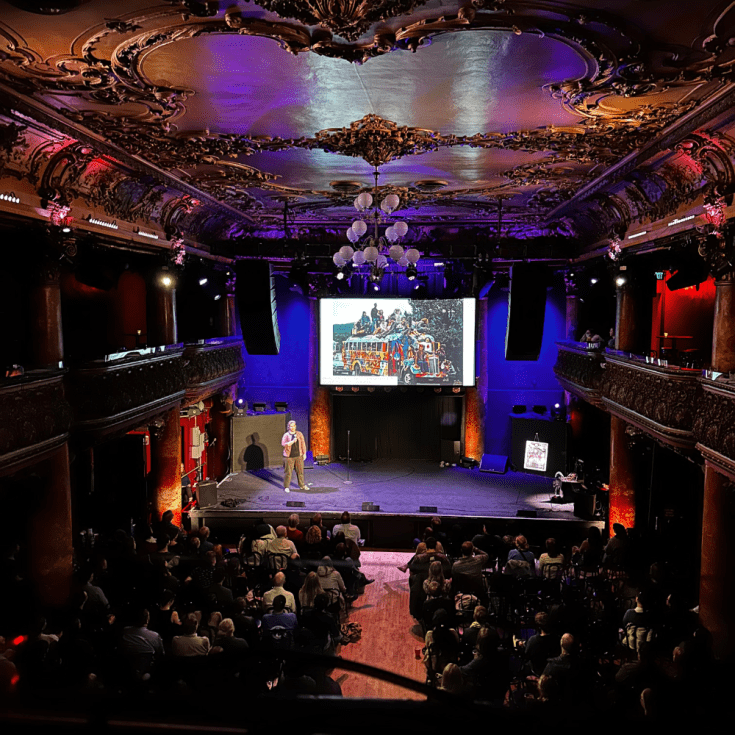
Quick. Bold. Creative. Leave the jargon in the poster hall. Speak for exactly five minutes and 20 slides.
Sponsored by NASA’s Earth Science Division and held in partnership with ESIP, Spark@AGU (formerly Ignite@AGU) enables scientists to showcase their professional and personal interests through fast, creative talks.
2025 Talks & Speakers
Purr-suasive Engagement: The Cat’s Playbook to Better Dialogue – Denise Hills
Dead Trees and Where to Find Them – Keenan Ganz
Driving Transformative Environmental Science in the Open Data & AI Era – Cibele Amaral
I Hate My Code: The Environmental Cost of Digital Bias – Amy Quarkume
Chasing Water Management in the Age of Algorithms – Sushant Mehan
How I Learned to Stop Worrying and Learned to Love AI – Sophia Parafina
Map It to Make It: Let’s Redraw Our Neighborhoods’ Futures! – Joan Jungbin Lee, Olivia Zhang
The Heartbeat of Nature: Listening Before It Fades – Nayani Ilangakoon
Using Space to Help Life on Earth – Seamus Lombardo
Can‘t Let Go: Life After NASA Program Management – Richard Eckman
- Spark@AGU Format
- Tips for Success
- Timeline & What to Expect
20 slides. Five minutes.
Every Spark@AGU talk is exactly five minutes long. No more, no less. Why? Because the slide deck is made of 20 auto-advancing slides.
Our organizing team works with speakers to develop a cohesive talk that pairs visual slides and easy-to-grasp language. The topic is up to you. The strict format pushes creative thinking and strong storytelling.
Looking for past examples? Search YouTube for “Ignite@AGU” to find playlists from the past 10+ years!
What Makes a Sparkling Talk?
- Images say a lot: Select one big image per slide
- Few words: Stick to single words, phrases, or maybe a bold sentence
- Repeat: Need more time? Want to make a point? Simply repeat the same slide and count repeats towards your total 20 (2x = 30 sec, 4x = 1 min, etc.)
- Tell a story: Think of your talk as a story with 18-20 lines.
- Get creative: Take risks, be funny, share something alarming. Be human!
- Titles: Write a bold, pithy title.
Psst! These tips work for ALL presentations, not just for Spark@AGU.
What's the timeline?
- Apply: September / October
- Get Notified & Train: November
- Present: December
Spark@AGU is a competitive process and we usually accept 10-12 speakers each fall to present at the AGU Annual Meeting in December.
Throughout the fall, we offer science communication training so your talk can shine! That means all speakers are expected to join one virtual practice session and work through edits with the organizing team. All speakers must attend an in-person tech rehearsal before the live event.